
Blog
Common CA Inter Exam Mistakes: What ICAI expects & How to avoid pitfalls

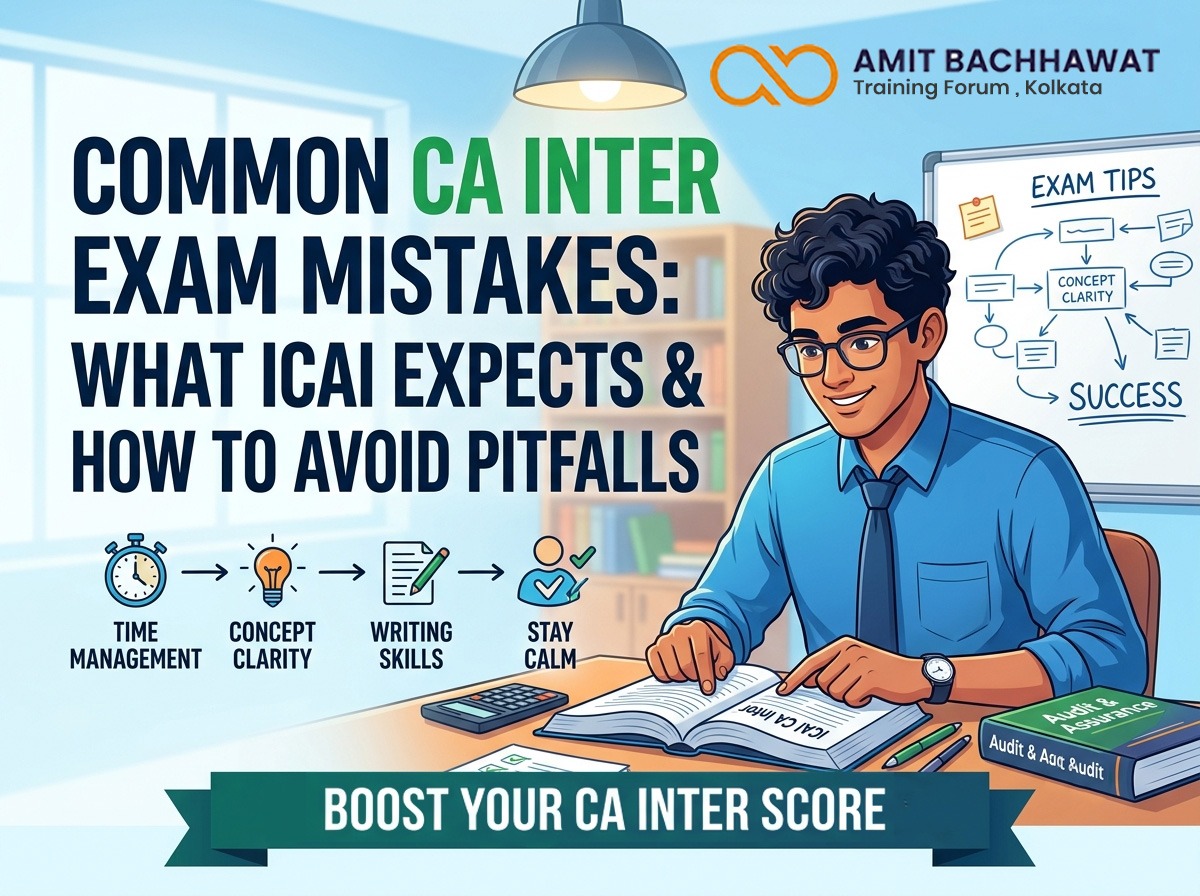
Preparing for the Chartered Accountancy Intermediate examination is one of the most demanding phases in a commerce student’s academic journey. The shear volume of the syllabus combined with the conceptual depth required makes it a formidable challenge. Every year, thousands of dedicated students put in endless hours of hard work, yet many fall short of the aggregate or pass marks. The difference between clearing the papers and missing out often comes down to small, repeated mistakes made during preparation and inside the examination hall. Understanding what the Institute of Chartered Accountants of India truly expects from your answers can transform your effort into results.
Table of Contents
Understanding the ICAI Evaluation Mindset
The primary disconnect for many students lies in understanding how ICAI evaluates answer scripts. Unlike university examinations where filling pages with general explanations might grant passing marks, CA Inter demands precision, technical correctness, and professional presentation. Evaluators work with strict suggested answers and marking schemes. When an examiner looks at your answer script, they are looking for specific legal terminology, relevant accounting standards, clear working notes, and logical conclusions.
ICAI expects candidates to demonstrate application-based understanding rather than simple rote memorination. When you face a scenario-based question in Law or Auditing, stating the correct provision of the law is only half the battle. The evaluator wants to see how clearly you link that legal provision to the facts given in the problem to arrive at a definitive conclusion. Missing this analytical link is one of the most common reasons students lose easy marks.
Major Pitfalls in Practical Papers
Practical subjects like Advanced Accounting, Financial Management, and Taxation are often considered scoring, yet students routinely lose crucial marks due to structural errors. A widespread mistake is skipping detailed working notes. In subjects like Advanced Accounting, working notes carry step-wise marks. Even if your final calculated figure is incorrect due to an arithmetic slip, complete and neatly presented working notes can secure most of the allocated step marks.
Another common pitfall is the lack of proper formatting and cross-referencing. Passing journal entries without proper narrations, drawing financial statement formats without column headers, or failing to cross-reference working note numbers in the main calculation makes it difficult for the examiner to follow your thought process. Clear presentation reflects professional competence, which is precisely what the institute tests. Additionally, in Taxation, failing to state the underlying assumptions clearly when multiple interpretations exist often leads to unnecessary deduction of marks.
Mistakes in Theory and Application Papers
Theory papers like Corporate and Other Laws, Auditing and Ethics, and Enterprise Information Systems require a different strategy altogether. The biggest mistake students commit here is writing long, unstructured paragraphs using generic, casual language. While exact word-for-word reproduction of study material is not strictly mandatory, using core technical terms and keywords from the official study text is essential.
In Law papers, writing answers without a proper structure hurts your scoring potential. An ideal answer to a case study question begins with the relevant provision and section reference, followed by an analysis of the facts of the case, and finishes with a clear, concise conclusion. Jumping straight to the conclusion without explaining the legal rationale signals a lack of conceptual clarity. Similarly, in Auditing, failing to cite relevant Standards on Auditing or using everyday English instead of audit terminology weakens the impact of your answer.
Examination Hall Strategy and Time Management
Even the best preparation can fail if your strategy during the three hours of the exam is flawed. The initial fifteen minutes of reading time are critical. Most successful candidates use this window to evaluate the question paper, select the optional question they want to skip, and decide the sequence in which they will attempt the rest. Attempting your strongest question first builds confidence and creates a strong initial impression on the evaluator.
Poor time management remains a silent killer. Students frequently spend excessive time crafting perfect answers for the first two questions, leaving insufficient time for the remaining paper. This leads to rushed writing, sloppy calculations, and unattempted questions toward the end. Every mark requires roughly one and a half minutes of your time. Leaving a twenty-mark question unattempted automatically reduces your maximum score to eighty, putting severe pressure on your accuracy across the rest of the paper.
How to Avoid These Common Traps
Overcoming these pitfalls requires a deliberate shift in your daily study routine well before the exams begin. First, prioritize writing practice over passive reading. Solving previous year papers and revision test papers under timed conditions trains your mind to organize thoughts quickly and write legibly under pressure. Passive reading gives a false sense of familiarity, whereas writing reveals actual gaps in memory and speed.
Second, align your preparation closely with ICAI study material. Make it a habit to highlight technical keywords, standard definitions, and legal phrases during your revisions. Incorporate these specific terms into your practice answers until they become natural to your writing style.
Finally, evaluate your performance through structured mock tests. Having your answers reviewed gives you neutral, objective feedback on your presentation errors, language gaps, and time management flaws. Correcting these mistakes during practice ensures you do not repeat them when it matters most. Approach your preparation with clarity, maintain a disciplined writing routine, and enter the exam hall with a structured execution plan.